 Skip to content

The Publish-Ready Review Checklist for AI-Assisted Video
Last updated: June 2026
By Michael / Marketing Media AI
A publish-ready AI-assisted video is not simply an exported file. It is a final asset reviewed for clarity, pacing, brand fit, technical quality, platform fit, and viewer action.
Answer capsule: A publish-ready AI-assisted video should be checked for message clarity, opening strength, pacing, brand fit, visual consistency, audio quality, caption accuracy, platform formatting, and whether the final version supports the intended viewer action. AI can support production, but final approval still requires human judgment.
Exported is not the same as publish-ready
An export only proves the file rendered. It does not prove the video is clear, credible, on-brand, or ready to represent the business.
AI-assisted output can look finished before the decision layer has been checked. Google’s guidance on generative AI content points publishers toward accuracy, quality, and relevance; Google’s people-first content guidance also emphasizes useful content for real readers. Apply the same standard to video: is the asset useful, accurate, and fit for the audience?
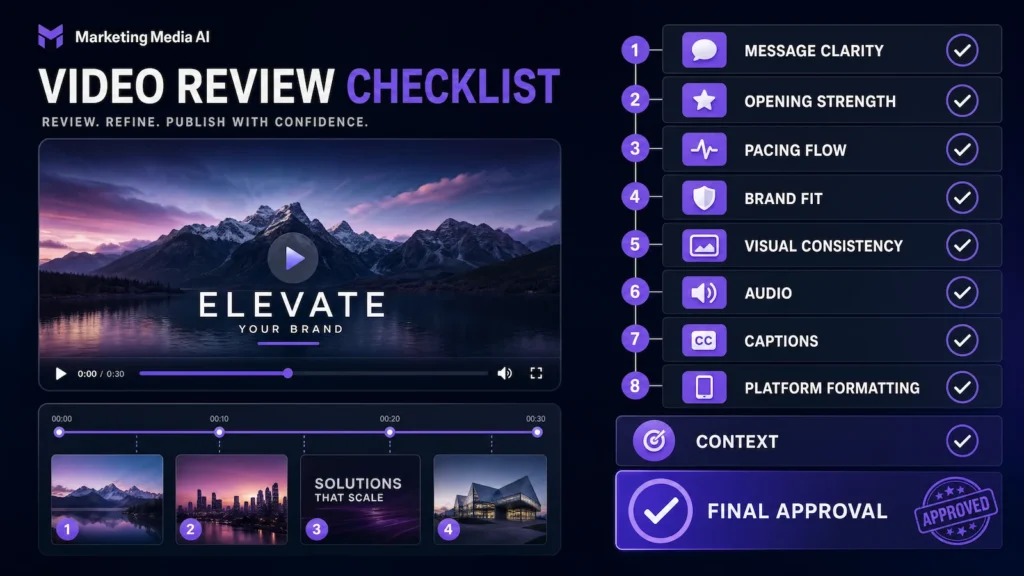
The Publish-Ready Review Checklist
Use this checklist after the AI-assisted edit is assembled, but before the asset is scheduled, uploaded, embedded, or sent to a client.
- Message clarity: Is the main point obvious?
- Opening strength: Does the first moment earn attention?
- Pacing and retention flow: Do cuts, pauses, captions, and transitions help the idea move?
- Brand fit: Does the edit feel credible for the brand and audience?
- Visual consistency: Do framing, graphics, AI visuals, colors, and typography belong together?
- Audio quality: Is the voice clear, leveled, and free from distracting artifacts?
- Caption accuracy: Are words, timing, names, and technical terms correct?
- Platform formatting: Do ratio, safe area, thumbnail frame, and export settings match the destination?
- Context and next step: Does the viewer know what the video means and what to do next?
- Final approval decision: Should this publish, revise, or be held back?
Check message clarity before checking polish
Message clarity comes before caption style, transitions, motion graphics, or export settings.
In a human-guided AI video production workflow, the first question is simple: what should the viewer understand? If that answer is vague, more polish will not fix the video.
Check the opening, main idea, proof point, and takeaway. If the strongest idea appears too late, move it earlier. If the clip needs missing context, add it or choose another section.
Review pacing and retention flow
Pacing should support attention, not just make the video feel fast.
AI-assisted tools can tighten dead space, add captions, generate variations, and prepare rough cuts, but they do not always know where the viewer needs emphasis, contrast, or a pause. This is why AI video output still needs human review.
A pacing pass checks the hook, section order, and whether cuts serve the message instead of hiding weak structure. Use an AI-assisted editing workflow so review happens before export.
Confirm brand fit and visual consistency
Brand fit is where many AI-assisted videos drift from useful to risky.
A tool may generate a clip, visual, caption style, or transition that looks impressive by itself but feels wrong next to the rest of the brand. That is the practical difference behind Marketing Media AI vs AI video tools: tools create output, but someone still has to judge fit.
Review the final video as a system. Do colors, crops, AI visuals, typography, music, b-roll, graphics, and tone belong together? If it would look random on the website, feed, or sales page, it is not publish-ready.
Check audio, captions, and platform formatting
Technical quality still matters, but it should be checked after message and pacing.
Review voice clarity, volume jumps, cleanup artifacts, room echo, awkward cuts, and music that competes with speech. Do not trust captions blindly. YouTube caption guidance says automatic captions can misrepresent speech because of accents, mispronunciations, dialects, or background noise, and recommends review.
Then confirm aspect ratio, safe areas, caption placement, end frame, thumbnail frame, file size, and export settings.
Make sure the video has enough context
A technically clean video can still fail if the viewer does not know why it matters.
Before publishing, check the page title, caption, post copy, email copy, or surrounding content. The video needs enough context to make the message understandable, especially for repurposed clips, AI scenes, demos, and short-form cutdowns.
Decide whether the video should actually be published
The final decision is not “does this look done?” It is “does this version deserve to represent the brand?”
Use three outcomes: publish, revise, or hold. Publish when message, pacing, brand fit, and platform version are ready. Revise when the direction is right but execution needs tightening. Hold when the video is polished but strategically weak, off-brand, confusing, or missing context.
How Marketing Media AI reviews AI-assisted video before publishing
Marketing Infrastructure Design™ for Video treats final review as part of the system, not a last-minute cleanup pass.
The review looks at four layers: intended message, attention flow, brand fit of AI-assisted elements, and whether the final version is safe to publish.
The issue we most often look for in the final review pass is not whether the video looks polished. It is whether the viewer can quickly understand the point, trust the sequence, and know what to do next. An AI-assisted video can have clean captions, sharp visuals, and a finished export while still feeling incomplete because the opening, pacing, or next step is not clear enough to publish.
That review layer is why AI-assisted video editing services should not be judged only by speed. Speed helps when decision rules are clear. Without human approval, fast output can still create message drift or brand inconsistency.
What to do if you want a human review before choosing the next step
If you already have footage, an AI-generated clip, or a rough edit, the next step is not always a full production scope.
Start with the Creator Brief. It gives Marketing Media AI the context needed to review the goal, format, source material, platform, and decision risk before recommending a path.
FAQ
What makes an AI-assisted video publish-ready?
An AI-assisted video is publish-ready when message, pacing, brand fit, audio, captions, platform formatting, and final human approval all work together.
Is a video QA checklist different from an export checklist?
Yes. An export checklist verifies file settings and specs. A video QA checklist also reviews message clarity, retention flow, context, brand fit, and publish risk.


