 Skip to content

Why Automated Clipping Still Needs Hook and Context Review
Last updated: June 2026
Automated clipping can help find possible short-form moments, but it should not be the final approval layer. Before an AI-selected clip gets published, it still needs review for hook strength, standalone context, pacing, payoff, and brand credibility.
Answer capsule: Automated clipping can help find possible short-form moments, but it still needs hook and context review before publishing. A usable clip needs a clear opening, enough setup, a reason to keep watching, a payoff, and platform-ready pacing. AI may find the moment; review decides whether it works as a complete clip.
Automated clipping can find moments, but not always complete clips
Automated video clipping is useful when the goal is to scan long footage faster and surface possible short-form moments. The problem starts when a highlighted moment gets treated as a finished short-form video.
A strong line, reaction, opinion, or explanation is only one part of the clip. The viewer still needs to know what they are watching, why it matters, and where the idea lands. That is why Marketing Infrastructure Design™ for Video treats AI as production support, not the editor, strategist, and final quality control system.
Third-party research on automatic long-to-short video editing makes the same distinction in technical terms: finding source clips and maintaining a coherent narrative are not the same job. See this research on automatic long-to-short video editing for a technical reference.
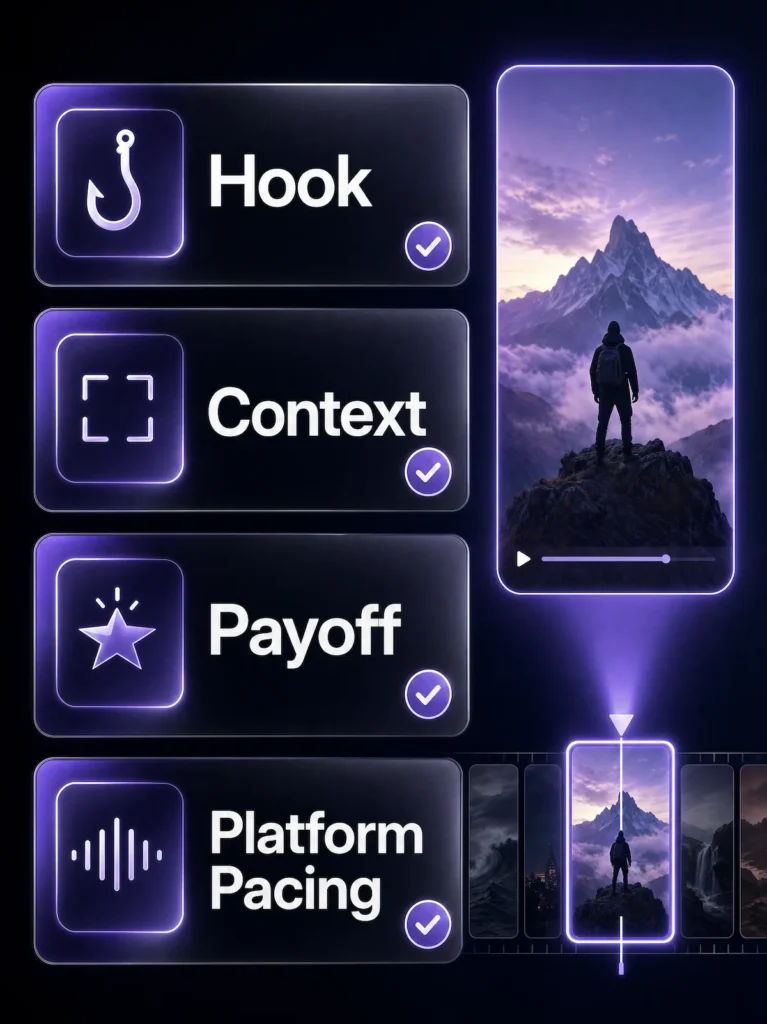
The Hook–Context–Payoff Review
The fastest way to improve AI clipping review is to judge every candidate clip as a standalone asset, not as a highlight from a longer video.
Use this checklist before publishing an AI-selected clip:
- Does the clip open with a clear reason to watch?
- Does the viewer understand what is happening without the full original video?
- Does the clip include enough setup before the main moment?
- Does the clip end after a clear payoff?
- Does the pacing fit the platform?
- Does the clip protect the speaker’s or brand’s credibility?
If the answer is weak on any of these, the clip may still be usable. It just needs editorial shaping before it becomes publish-ready.
Why a highlight is not automatically a short-form video
A highlight is the moment the source video gets interesting. A short-form video is a complete viewing experience built around attention, clarity, and payoff.
This is where automated clipping often breaks. It may start where the speaker says the strongest sentence, but the viewer has no setup. It may keep the reaction, but not the question that made the reaction matter. It may trim the length, but leave the first three seconds too slow for Reels, Shorts, TikTok, or LinkedIn.
This is why the best short-form moment is not always the best clip; the selected moment still needs enough setup, pacing, and payoff to work on its own.
What context review catches before publishing
Context review catches the gaps that make a clip feel random, confusing, or accidentally misleading.
A clip pulled from a podcast, webinar, interview, lesson, or founder video usually depends on something around it. The missing context may be the question, the objection, the audience type, the product being discussed, or the reason the speaker is making the point.
Before approving an AI-selected clip, review whether the viewer can answer three questions quickly: What is this about? Why should I care? What changed by the end?
What we check before approving an AI-selected clip
When we review AI-selected clips, the issue is usually not that the selected moment is bad. It is that the clip starts too late, after the viewer already needed setup. The strongest line may be there, but the hook, context, or payoff has to be rebuilt before the clip feels publishable.
That first-hand observation should be added before publishing because it gives the article practitioner credibility that a generic AI clipping article will not have.
What hook review catches before publishing
Hook review catches whether the first seconds create a reason to keep watching.
The best hook is not always a loud claim or oversized caption. For authority-led content, the hook often works because it makes the problem specific. AI short-form editing can suggest openings, captions, and rough clip windows. Human review decides whether the opening feels clear, credible, and aligned with the brand.
Why clip endings matter more than most people think
The ending decides whether the clip feels complete or cut off.
Many automated clips stop as soon as the strongest line is delivered. That can work if the line is the payoff. It fails when the viewer still needs the consequence, example, next beat, or CTA handoff. A clean ending does not have to over-explain; it needs to close the idea.
Where AI-assisted short-form editing helps
AI-assisted short-form video editing helps most when AI is used to speed up review, organization, caption prep, cleanup, format prep, and clip discovery.
That support can reduce time spent searching through long recordings and give the editor better starting points. It can also help prepare AI shorts from long video without turning the workflow into random volume. The final pass still needs structure: clip window selection, hook order, caption rhythm, pacing compression, and platform fit.
When a human review pass is still needed
A human review pass is still needed whenever the clip represents the brand, explains an offer, teaches a point, carries a founder’s voice, or supports a larger content system. Use automated clipping when you need options. Use review when the asset will be published under your name.
For broader editing support beyond clips, use AI-assisted video editing services. For a focused vertical asset, short-form social video editing is the better fit.
What to do if you already have long-form footage
If you already have podcasts, webinars, interviews, lessons, founder videos, or rough recordings, do not start by asking, “How many clips can we get?” Start by asking, “Which moments can stand alone?” Scan for candidates, filter each one for hook, context, payoff, and platform fit, then tighten captions, pacing, safe zones, and framing.
If you have footage ready, use Start Your Project for a lower-commitment first edit. If you need help deciding the right workflow before scoping the project, use the Infrastructure Brief.
FAQs about automated clipping review
Can AI clipping tools find good short-form moments?
Yes. AI clipping tools can help surface possible moments from long videos. The issue is not discovery. The issue is whether the selected clip has a clear opening, enough context, tight pacing, and a complete payoff.
What is the best first review pass for AI shorts from long video?
Start with hook, context, and payoff. If the viewer does not understand the point quickly, cannot follow the setup, or feels like the clip ends too early, the edit needs more work before publishing.


