 Skip to content
When AI Video Tools Are Enough — and When They Become the Problem
Last updated: June 2026
By Michael / Marketing Media AI
AI video tools are enough when the job is contained, low-risk, and clearly defined. They become the problem when they are expected to make decisions about message structure, pacing, brand consistency, workflow, approval, or whether the final video is actually worth publishing.
Answer capsule: AI video tools are enough when the task is narrow, repeatable, and already directed. A structured production system is needed when the issue involves message strategy, retention, brand fit, approval flow, repeated output, or final publishing judgment. The real question is not which tool is best; it is where the bottleneck lives.
AI tools are useful when the task is contained
AI tools can reduce production drag when the input, goal, and review standard are already clear. The current AI video editing tool landscape includes tools that can generate, edit, manage, and distribute video content, which is useful for task execution. The mistake is treating execution as the whole production system.
A tool can help clip a long video. It can clean audio. It can resize a finished edit. It can generate caption options, create rough visual support, or speed up versioning. Those are real advantages when the creative direction has already been decided.
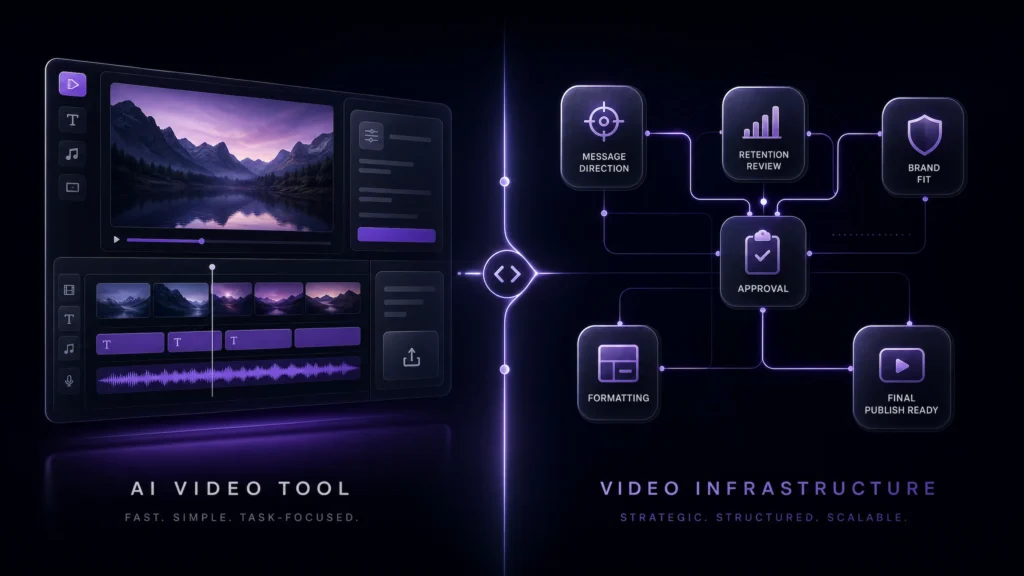
The problem starts when the tool is asked to decide what the viewer needs to hear first, which moment should be cut, what promise should lead the video, where trust is lost, or whether the piece fits the brand. Those are not button-click problems. They are production judgment problems.
The Tool Enough / Infrastructure Needed diagnostic
The fastest way to decide is to separate task problems from system problems.
| Tool Enough | Infrastructure Needed |
| Task-only problem: “I need captions, clips, cleanup, or a format change.” | Structural message problem: “The video is polished but the point is unclear.” |
| Technical cleanup problem: “The audio needs noise reduction or the framing needs help.” | Retention/pacing problem: “People drop off because the sequence does not hold attention.” |
| Formatting/versioning problem: “The approved video needs vertical, square, or shorter versions.” | Brand consistency problem: “Every video feels slightly different, even when the offer is the same.” |
| Clear input + clear output: “This footage needs one specific change.” | Review/approval problem: “Nobody knows what counts as ready to publish.” |
| One-off asset need: “We need a quick draft or internal version.” | Repeatable production system problem: “We need a reliable way to produce more videos without losing quality.” |

When an AI video tool is probably enough
An AI video tool is probably enough when the job has a fixed instruction and a low-risk outcome.
Use the tool when the source material already has a clear message, the audience already understands the offer, and the edit does not need heavy judgment. A founder clipping one strong answer from a webinar may not need a full production path. A team resizing an approved video for another placement may only need formatting support. A creator removing filler words from a rough talking-head clip may only need cleanup and review.
This is where AI tools are strongest: speeding up repetitive work around a decision that has already been made. The tool should support the workflow, not become the strategist, editor, producer, and final approver at the same time.
When the tool becomes the wrong solution
The tool becomes the wrong solution when the video problem is being misdiagnosed as a software problem.
If the hook is weak, a faster editor will not fix the offer. If the viewer does not understand why the message matters, better captions will not save the sequence. If the brand voice changes from clip to clip, more templates will only spread the inconsistency faster.
At Marketing Media AI, a tool-first path makes sense when the task is already defined and the risk is low. A structured production path makes sense when the footage needs diagnosis, message ordering, retention review, brand control, and a clear approval standard before output scales.
The review standard we use is simple: an AI-assisted edit is not finished just because the captions are clean, the cuts are smooth, or the format is correct. It still needs to be checked for message order, retention pacing, brand fit, and whether the final version supports the actual goal of the video.
The signs your bottleneck is infrastructure, not software
A video infrastructure problem usually shows up as repeated confusion, not one bad export.
You are probably dealing with infrastructure when your team keeps re-editing the same type of video, cannot agree on what “done” means, publishes clips that look finished but feel weak, or uses different standards every time a new asset is created.
Another sign is tool hopping. If every new platform looks like the answer for two weeks and then creates the same problem in a new interface, the missing layer is probably not software. It is the decision system around the software.
This is where a video infrastructure bottleneck becomes useful to identify, because the issue may be foundation, retention, workflow, or scaling before it is a software problem.
Why better tools do not automatically create better retention
Retention depends on sequence, timing, relevance, and trust; a tool can assist those choices, but it cannot own them by default.
A video can be visually polished and still lose the viewer because the opening takes too long, the strongest point is buried, the proof arrives late, or the edit feels disconnected from the offer. AI can suggest cuts, captions, transitions, and alternate versions. It still needs a human review layer that understands the viewer, the platform, the brand, and the purpose of the video.
For short-form content, this matters because the first few seconds often decide whether the rest of the edit gets a chance. For long-form content, it matters because structure determines whether the viewer can follow the argument without feeling dragged through unnecessary material.
How Marketing Infrastructure Design™ changes the decision
Marketing Infrastructure Design™ for Video changes the decision by looking at the system behind the asset before choosing the production path.
Instead of asking, “Which AI tool should make this?” the better question is, “What does this video need to accomplish, and what part of the workflow is blocking that outcome?”
Sometimes the answer is a tool. Sometimes it is a human editor. Sometimes it is a structured production workflow that defines the message, maps the edit, reviews retention, prepares versions, and sets a clear publishing standard. That distinction is the difference between faster output and stronger production capacity.
Which next step fits your situation
Choose the next step based on the actual constraint, not the newest feature list.
If you are still comparing the broader system, read AI video tools vs human-guided video infrastructure. It explains the difference between standalone tool use, human review, and infrastructure around repeated video output.
If you are deciding whether Marketing Media AI is a better fit than a tool-only path, read Marketing Media AI vs AI video tools.
If you are not sure where the bottleneck is, start with the Video Infrastructure Scorecard. It is the better fit for diagnostic readers who need to identify the weakest point before choosing a service.
If you already know you need direction before scoping the work, use the Infrastructure Brief so the starting path can be reviewed before you commit to the wrong editing route.
FAQ
Are AI video tools enough for short-form videos?
They can be enough for clipping, captions, resizing, cleanup, and quick drafts. They are usually not enough when the short-form video needs stronger message order, hook judgment, brand control, or a repeatable review process.
When should I hire a video editor instead of using an AI tool?
Hire editing help when the footage needs judgment, pacing decisions, narrative flow, brand fit, or final polish that affects how the audience understands the message. Use a tool when the task is narrow and already directed.
Should I use AI video tools or an agency?
Use tools when you need task support. Consider a structured production partner when the issue involves strategy, review, workflow, approval, repeated publishing, or unclear production standards.


