 Skip to content

What a Video Infrastructure Bottleneck Looks Like Before You Scale
Last updated: June 2026
A video infrastructure bottleneck usually shows up before your team thinks it has a volume problem. The warning sign is simple: every attempt to create more video makes clarity, review, approvals, retention, or platform fit worse.
Answer capsule: A video infrastructure bottleneck appears when production volume increases but clarity, consistency, feedback, approvals, retention, or platform-readiness get worse. The issue is usually not a lack of content. It is missing structure for how video ideas, edits, reviews, and publishing decisions move through the system.
A bottleneck usually appears before the content volume problem
Most teams misread video inconsistency as an output problem. They assume they need more clips, editors, AI tools, or a bigger content calendar. Sometimes they do. But the earlier problem is often structural: the system cannot repeat the decisions that made the strongest videos work.
The workflow may be active, but the decision path is unstable. Openings are improvised, feedback lands in different places, and platform versions get made without a clear standard for readiness.
At Marketing Media AI, this is where Marketing Infrastructure Design™ becomes useful: diagnose the weak layer before scale makes it more expensive. A good first step is the Video Infrastructure Scorecard, which helps separate foundation, retention, workflow, and scaling constraints.
Five bottleneck signals before you scale
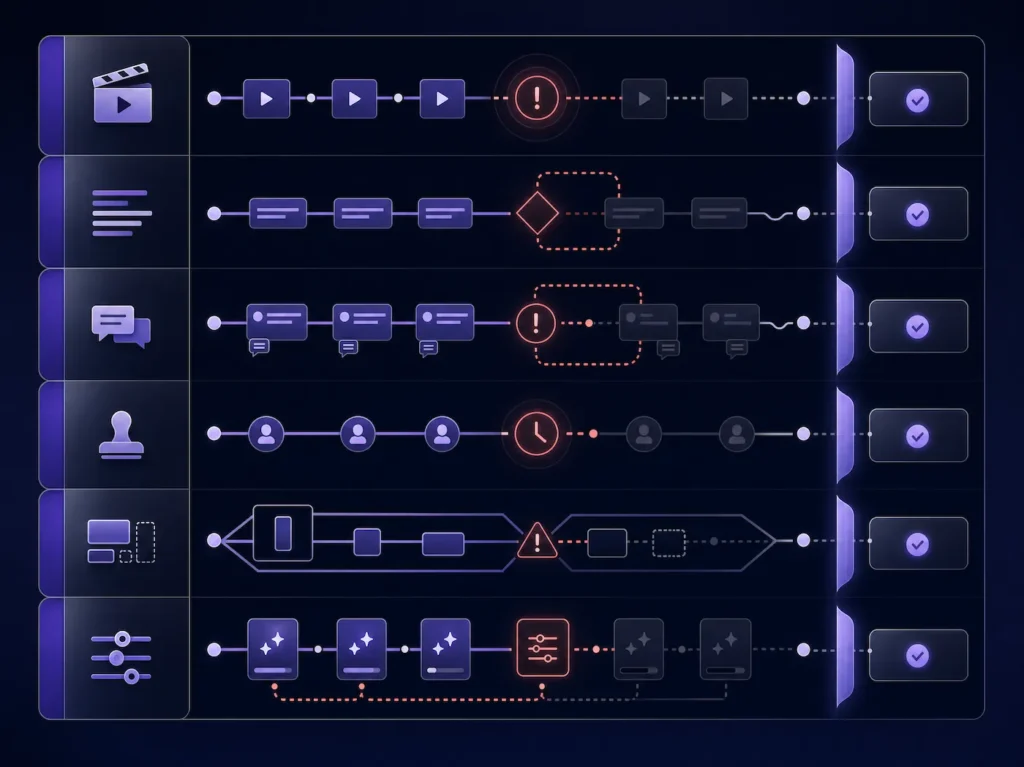
Before increasing cadence, look for these five signals. Several together mean the video content system needs structure before volume.
- Inconsistent openings: each video starts with a different type of promise, pace, or setup.
- Unclear message flow: the content has useful ideas, but the order is hard to repeat.
- Scattered feedback: notes are spread across email, DMs, comments, calls, and memory.
- Slow approvals: every new version creates more discussion instead of a clearer publish decision.
- Uncontrolled output: formats, retention patterns, and AI-assisted versions increase faster than review standards.
Signal 1: Your openings change from video to video
The opening is not a style detail. It sets the viewer expectation and decides whether the rest of the edit has a chance to work.
A weak video workflow treats every opening as a fresh creative decision. One clip starts with context. Another starts with a broad claim. Another jumps straight into a tip. The fix is to define what the opening must accomplish based on the content type, not force every video into the same hook template.
Signal 2: The message flow is hard to repeat
A scalable video process needs repeatable message logic, not copied scripts. When flow is unclear, every edit becomes a one-off rescue mission.
You may notice that the final video works only after several rounds of rearranging. The source material has value, but the best order is discovered late. The video infrastructure method explains the larger diagnostic model, but this article is focused on the symptom: if message order has to be rediscovered every time, scale will multiply the confusion.
Signal 3: Feedback is scattered or subjective
Feedback becomes a bottleneck when it does not tell the editor what to change. “Make it tighter,” “it feels off,” or “can we make it more engaging?” may be valid reactions, but they are not production instructions.
Common workflow symptom to verify before publishing:
The clearest symptom we usually catch is when a video looks edited, but the feedback is all over the place. One person reacts to pacing, another reacts to captions, another reacts to the hook, but the real issue is that the opening and message flow were never clearly defined before the edit started.
A cleaner review structure separates preference from performance. Preference is taste. Performance is whether the opening is clear, the pacing supports retention, the format fits the platform, and the final version supports the business goal.
Signal 4: Approvals slow down as output increases
A true approval bottleneck is usually an unclear standard for what “ready” means. When one video becomes three versions, vague approvals start to break the system. Stakeholders review different details, question settled decisions, or give notes on older versions.
Before scaling, define the approval standard. What must be true before a video can ship? What is a required fix? What is a preference? Who has final say on message clarity and platform-readiness?
Signal 5: AI creates more versions than the system can control
AI can increase production capacity, but it can also expose weak infrastructure. More clips, captions, crops, hooks, and variants are useful only if the system can decide what belongs in public.
That is the difference between tool speed and production control. The AI video tools vs human-guided video infrastructure page explains this distinction in more depth: tools are useful when the job is clear, while infrastructure matters when the system itself is unclear.
This connects to the larger AI tools vs infrastructure decision: the tool may help with execution, but infrastructure determines whether the system can choose, review, and control what gets published.
From a search and content quality standpoint, the safer direction is useful, original, people-first output rather than commodity volume. Google’s guidance on creating helpful content supports that quality-first lens without promising rankings or visibility from any single tactic.
Why more content makes the bottleneck louder
Scaling does not create the bottleneck. It reveals it.
If the opening standard is weak, every extra video adds another inconsistent first impression. If the review process is scattered, every added version creates more places for feedback to drift. If AI creates variations without a clear approval layer, volume rises while confidence drops. The better first question is: which part of the video system gets worse when we ask it to produce more?
How Marketing Infrastructure Design™ helps diagnose the issue
Marketing Infrastructure Design™ looks at the system behind the asset. For video, that means diagnosing the layers that control clarity, retention, production rhythm, AI support, review, and publishing.
The point is to remove avoidable uncertainty. Clear opening roles speed editing. Repeatable message flow cleans up revisions. Defined AI support helps the workflow instead of flooding it.
What to do before scaling production
Before adding more video output, tighten the system that decides what should be made, edited, approved, and published.
- Audit recent videos for the five bottleneck signals above.
- Define the job of the opening for each recurring content type.
- Map the message flow before editing begins.
- Move feedback into one review path with clear decision ownership.
- Decide where AI can assist and where human review must protect quality.
- Choose the right production path from Marketing Media AI services only after the bottleneck is clear.
If you are unsure where the system is breaking, start with the Video Infrastructure Scorecard. It is built for diagnosis, not generic scoring, and gives you a clearer first move before you scale.
FAQ
What is a video production bottleneck?
A video production bottleneck is the point where progress slows, quality drops, or decisions become unclear. In a marketing video workflow, it may be the opening, message flow, feedback process, approval standard, platform formatting, or AI review layer.
How do I know if my video workflow bottlenecks are caused by infrastructure?
Look for patterns across multiple videos. If each project repeats the same unclear opening, scattered feedback, slow approval, or format mismatch, the issue is likely systemic.
