 Skip to content

How to Use AI Ad Variations Without Creating Random Creative Drift
Last updated: June 2026
By Michael / Marketing Media AI
AI ad variations are useful when they test a controlled creative variable. They become random when the hook, offer, proof, visual style, pacing, and CTA all change at once.
Answer capsule: AI ad variations are useful when they test one controlled creative variable at a time. They become random when every version changes the hook, offer, proof, visual style, pacing, and CTA together. More versions do not automatically create better testing. A useful variation system protects brand consistency while making each test easier to interpret.
More ad variations are not useful if the test becomes random
More ad versions only help when each version has a clear job. If one version changes the opening line, another changes the offer, another changes the product framing, and another changes the visual language, the campaign may have more assets but less learning.
This is the problem with many AI ad creative variations. AI can make fast versions, but speed does not tell you what the audience responded to. A testing pack needs a fixed creative base, a known variable, and a review path before export.
For Marketing Media AI, this fits the larger Marketing Infrastructure Design™ view: structure the system first, then let AI support production. The goal is not five unrelated ads. The goal is five useful test paths from one controlled campaign idea.
The One-Variable Variation Rule
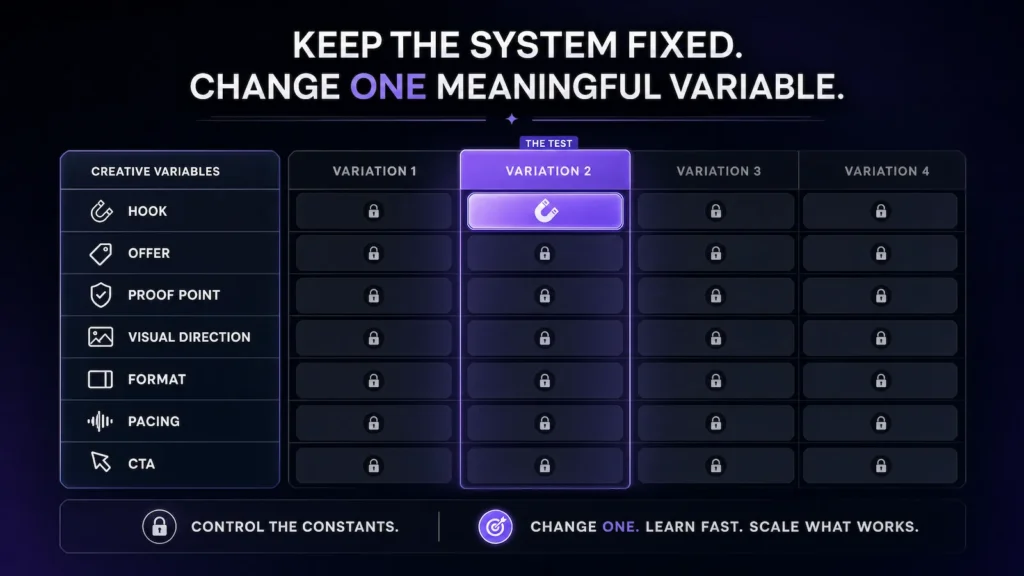
The One-Variable Variation Rule keeps AI ad testing readable by changing one primary creative variable at a time.
Before generating more versions, decide which variable the next test is supposed to study:
- Hook
- Offer
- Proof point
- Visual direction
- Format
- Pacing
- CTA
For example, a hook test can change the opening problem, curiosity angle, or first proof cue while the offer, visual style, CTA, audience, and format stay consistent. Changing several variables can be useful during concept exploration, but it is not controlled testing.
What creative drift looks like in AI ad variations
Creative drift shows up when the versions no longer feel like they belong to the same campaign, brand, or test.
Common signs include unrelated hooks, mixed visual styles, inconsistent promise language, conflicting audience assumptions, changing CTA paths, and tone that shifts from premium to casual without a reason.
The drift usually shows up when the variations look visually different but do not answer a cleaner testing question. One version changes the hook, another changes the offer, another changes the visual direction, and another changes the CTA. At that point, the output looks productive, but the test is too scattered to learn from.
The issue is not that the ads look different. The issue is that the difference is not controlled, so the team cannot confidently say what the test proved.
What to keep fixed before generating more versions
A useful AI ad variation system locks the campaign foundation before it expands the creative.
Keep these items fixed unless they are the specific variable being tested:
- Core offer or promise
- Primary audience
- Brand tone
- Approved claims and proof limits
- Visual system or reference direction
- Landing page message match
- Platform and placement target
This is where AI visual systems matter. If the brand has no reusable visual direction, each AI ad prompt starts from a different creative center. The results may look polished but still feel disconnected.
When the source footage, visual language, or campaign structure is part of a larger workflow, AI-assisted video production services can help organize the production map before more versions are created.
What to change one variable at a time
Controlled variation means choosing the one creative question the next version is meant to answer.
If you are testing hooks, change the first three to five seconds. Keep the offer, proof, CTA, and design direction stable. If you are testing proof, keep the hook and CTA stable while changing the testimonial, feature proof, demonstration moment, or authority cue.
If you are testing visual direction, keep the message structure stable while changing the environment, graphic treatment, crop behavior, product emphasis, or scene style. The more specific the variable, the easier it is to interpret the result.
How to review AI ad variations before publishing
Every AI ad variation should pass a human review before it is handed to a media buyer, uploaded to a platform, or sent into a campaign.
Use this review pass:
- Test clarity: Can you name the one variable this version changes?
- Message match: Does the ad still match the landing page and offer?
- Brand fit: Does the ad still feel like the same company?
- Format fit: Is the crop, pacing, and composition right for the placement?
- Claim control: Are claims, pricing, guarantees, and proof points still accurate?
- Platform check: Are current specs and policies verified before upload?
For platform-specific details, verify current Meta ad creative specifications, Google Ads video ad specifications, and the Meta Advertising Standards before publishing. Platform requirements and review policies can change, so do not rely on an old export checklist.
Where AI ad variations help
AI ad variations help most when a brand already has one clear campaign idea and needs more controlled versions to test.
Good use cases include hook testing, offer-angle testing, retargeting refreshes, product demo cuts, CTA framing, paid social cutdowns, and adapting one campaign concept into multiple placement-ready versions.
The strongest starting point is not a blank prompt. It is a clear offer, useful source assets, audience context, brand references, platform target, and a short note on what should change or stay fixed.
When you need a visual system before more ads
You need a visual system before more ads when each new batch starts drifting away from the last one.
That usually means the bottleneck is not variation volume. It is brand control. The visual language, composition rules, lighting direction, product treatment, and prompt logic have not been defined tightly enough to repeat.
This connects directly to why AI visuals drift off-brand when the brand system is not defined before new creative variations are generated.
If the campaign needs repeatable visual rules across ads, landing page graphics, thumbnails, and future creative batches, start with AI visual systems before producing another disconnected set of ads.
What to do if your ad creative needs controlled variation
If the offer is already clear, start with AI ad variations and define the one variable each version should test.
If the scope is larger than one contained ad variation pack, use the Custom Quote path so the work can be scoped around mixed deliverables, campaign support, or a broader creative system. If you are not sure which starting point fits, send an Infrastructure Brief so the workflow can be reviewed before production expands.
The goal is simple: create more versions without losing the campaign. AI can speed up the build, but the structure still decides whether the variations teach anything useful.
FAQs
How many AI ad variations should I make from one concept?
Start with enough versions to test meaningful differences, not as many as the tool can generate. Three to five controlled versions are often more useful than twenty random versions.
Should every AI ad variation look different?
No. The versions should be meaningfully different in the variable being tested, but still connected by the same offer, brand direction, audience, and campaign goal.
When should I change multiple variables at once?
Change multiple variables when exploring broad concept directions, not when trying to read a controlled test. Once a promising direction is found, narrow the next round to one primary variable.


