

Market Research Firms Using AI Moderation: Who’s Leading the Industry?
If you’re asking which market research firms use AI moderation, the answer is no longer “just a few early adopters.” AI-moderated interviews, conversational surveys, and automated qualitative analysis are becoming part of the modern research stack. Firms are using AI to guide conversations, ask follow-up questions, detect themes, and shorten reporting timelines without removing human judgment entirely.
In this article, we break down what AI moderation means, why companies are adopting it, which firms are leading the space, and where the technology is heading next. For brands evaluating how AI fits into broader marketing systems, this shift matters because faster research loops can improve messaging, creative direction, and campaign decisions.
|
Quick Note: At Marketing Media AI, we pay attention to these shifts because faster research loops can improve how teams shape messaging, content, and creative direction. If you want to see how that connects to execution, explore our services or browse the blog. |
What Is AI Moderation in Market Research?
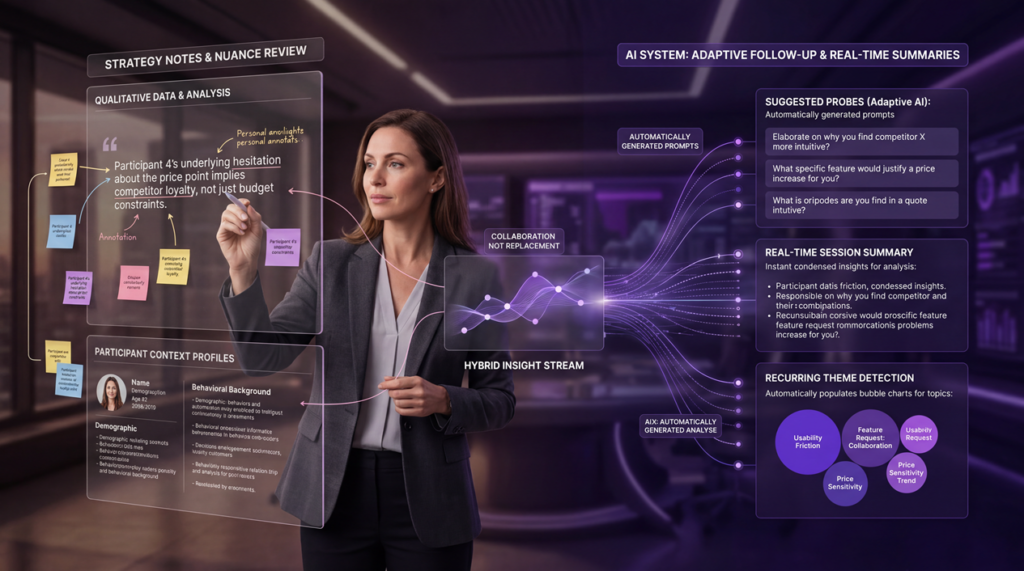
AI moderation is the use of artificial intelligence to help guide, analyze, and synthesize qualitative research sessions such as interviews, focus groups, and conversational surveys. Instead of relying on a human moderator for every interaction, AI systems can support the process by:
1. Asking adaptive follow-up questions
2. Detecting sentiment and recurring themes
3. Generating summaries and insights in real time
In practice, the strongest setups are usually hybrid. AI handles consistency, scale, and first-pass analysis, while human researchers still shape the study design, interpret nuance, and make the final decisions. That balance makes AI moderation more scalable without reducing research to a cold, fully automated script.
|
Definition: AI focus groups are research sessions that use conversational AI to replicate some functions of a traditional moderator, such as prompting, probing, and synthesizing responses. Many platforms still involve real participants and human researchers. The value is speed, consistency, and scale—not the full replacement of human judgment. |
What Are the Benefits of AI-Moderated Research?
1. Significant Cost and Time Efficiency
Traditional qualitative studies can be slow and labor-intensive. AI moderation reduces manual workload, accelerates fieldwork, and shortens the path from raw responses to usable findings.
2. Rapid, Scalable Insights
AI research tools can run many interviews or conversational surveys at once, making it easier to gather a wider range of perspectives without the same scheduling bottlenecks as traditional qualitative research.
3. More Consistent Moderation and Pattern Detection
Human moderators can introduce inconsistency from one conversation to the next. AI can apply the same logic more consistently, while also helping researchers identify patterns in tone, language, and response themes. That said, AI does not eliminate bias on its own—study design still matters.
4. Real-Time Analysis and Synthesis
One of the biggest advantages of AI moderation is speed. Instead of waiting days or weeks for a synthesis report, teams can review dashboards, transcripts, and clustered themes almost immediately.
5. Deeper Follow-Up Through Adaptive Questioning
Well-designed systems can adjust follow-up questions based on what a participant says, which creates richer conversations than rigid, static surveys and improves the quality of the qualitative layer.
6. Better Accessibility for Global or Complex Studies
AI-driven moderation can make multilingual or large-scale studies easier to manage, helping firms run research across regions and audience segments with fewer logistical constraints.
What Are Some Leading Firms Using AI Moderation?
If the question is which firms are visibly pushing AI moderation forward, these are some of the clearest names in the space right now:

|
Company |
What they’re known for |
|
Suzy Speaks is positioned around AI-moderated conversational research that helps brands collect qualitative insight at much greater speed. | |
|
Glaut focuses on AI-moderated interviews layered into quantitative studies, giving research teams more depth without slowing delivery. | |
|
Yasna.ai is built around conversational in-depth interviewing at scale, with AI support across setup, interviewing, and reporting. | |
|
Conveo emphasizes AI-led interviews and rapid video-based analysis, aiming to speed up the full qualitative workflow from study design to synthesis. | |
|
NewtonX offers AI-moderated interviews designed to bring qualitative depth to research faster and more cost efficiently than traditional approaches. |
Beyond these dedicated AI-moderation players, broader consumer-insights platforms such as Zappi are also embedding AI more deeply into research workflows. The important distinction is that some firms are built around AI-moderated interviews specifically, while others use AI more broadly across the insights stack.
How Video Teams Use AI Research Signals
Video editing agencies do not usually moderate research sessions themselves. More often, they use AI-generated research outputs—such as transcripts, sentiment cues, key-moment tagging, and summaries—to shape creative decisions.
For a company like Marketing Media AI, that can mean turning audience interviews or focus group findings into sharper hooks, clearer messaging, and stronger story structure. When the research layer gets faster, the content layer can usually iterate faster too. That is also why the connection between research, content systems, and AI-assisted production is becoming more important.
|
Perspective: When research insights become easier to extract, creative teams can spend less time digging through raw feedback and more time turning those findings into messaging and content that people actually watch. |
Human vs AI Moderation: The Differences
Automated research moderation brings speed, consistency, and scale. Human moderators still bring empathy, context, and cultural sensitivity. For most serious research teams, the best answer is not human or AI. It is a hybrid model.
Human moderation: best for emotionally sensitive discussions, complex nuance, and situations where live judgment matters.
AI moderation: best for repeatable questioning, high-volume interviews, real-time synthesis, and faster turnaround.
Hybrid moderation: best when AI handles repetitive execution and humans handle research design, interpretation, and high-stakes nuance.
Future Trends of AI Moderation
• Closer integration with qualitative research software and survey platforms.
• More natural, multilingual interviewing powered by advances in natural language processing and sentiment analysis.
• Expansion into video, audio, and multimodal research environments.
• Wider adoption among smaller firms as tools become cheaper and easier to deploy.
• Stronger scrutiny around privacy, transparency, consent, and bias.
As more teams ask whether they should adopt AI moderation, the real question is no longer whether the technology is coming. The real question is where it fits inside their research process and how much human oversight they want to preserve.

Conclusion
AI moderation is reshaping market research by making qualitative insight faster, more scalable, and easier to operationalize. Firms such as Suzy, Glaut, Yasna.ai, Conveo.ai, and NewtonX show that AI-moderated interviews and analysis are moving from experimentation into normal research practice, while platforms such as Zappi show how AI is also expanding across the wider consumer-insights ecosystem.
For brands and agencies, the key point is simple: AI works best when it strengthens process quality instead of pretending to replace judgment. The firms that gain the most from it will be the ones that combine automation, sound research design, and human interpretation. If you want to explore the broader marketing side of that shift, read What Is an AI Marketing Agency? or What Is Artificial Intelligence in Content Marketing?.