
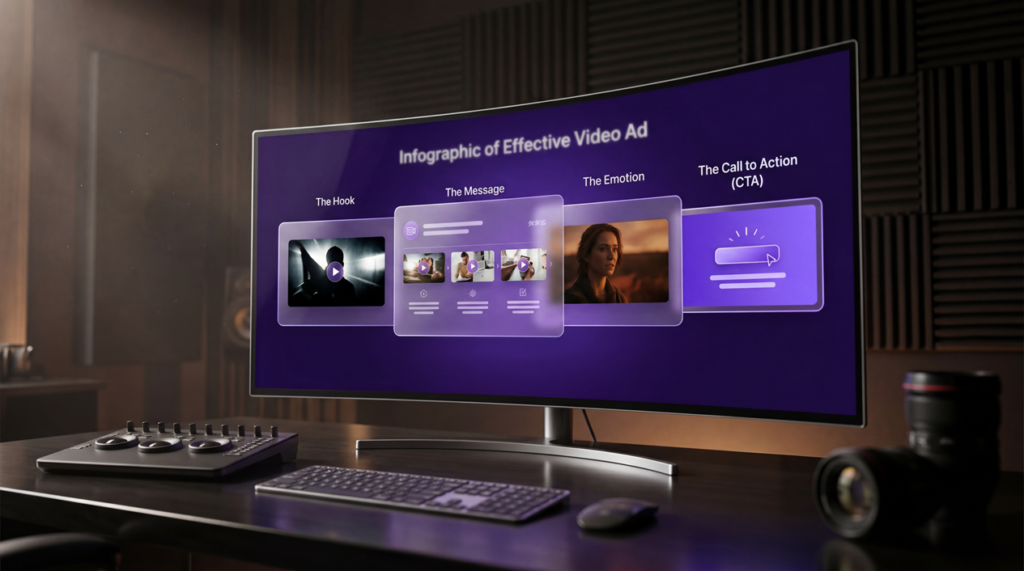
How Do You Make an Effective Video Ad? Proven Steps and Tips
In 2026, video advertising remains one of the most widely used marketing formats. If you are a small business owner, marketer, or content creator, learning how to make an effective video ad matters because stronger creative usually means better retention, clearer positioning, and more conversions.
In this guide, we break the process down step by step, cover the principles behind high-performing ads, highlight common mistakes to avoid, and show you how to measure results. The goal is not just to make a video ad that looks good, but to make one that is structurally built to perform.
What Makes a Video Ad Truly Effective?
An effective video ad is a focused message built to earn attention and move the viewer toward a next step. The strongest ads are clear, fast to understand, emotionally resonant, and aligned to the platform where they run.
At a strategic level, most high-performing ads rely on a few core elements:
- Storytelling: People remember narratives more than disconnected product claims.
- Emotional connection: Ads that create curiosity, urgency, confidence, or desire are more likely to hold attention.
- Clarity: The viewer should understand the offer, the value, and the point of the ad quickly.
- Call to action (CTA): Even a strong ad underperforms when the next step is vague or missing.
- Platform fit: Creative should match the viewing behavior, format, and expectations of the platform where it runs.
When those pieces work together, the ad feels intentional instead of random. That is the difference between content that gets watched and content that gets skipped. If you want help executing at that level, our video ad editing service is built to combine creative polish with performance structure.
Step-by-Step Guide to Creating an Effective Video Ad
Step 1: Define Your Audience and Goals
Before you write a script or shoot a single frame, get specific about who the ad is for and what action you want the viewer to take. Clear goals shape everything that follows, including the hook, message, pacing, CTA, and landing page experience. Without that clarity, time and budget are usually wasted on creative that looks active but does not move the business.
Step 2: Write a Script
Knowing how to write a video ad script sits at the center of the process. A good script is concise, conversational, and built around benefits rather than feature dumping. It should move quickly, sound natural, and create a clear reason to keep watching.
Start with the problem, introduce the value, remove friction, and lead naturally into the CTA. If you want help with ideation or first drafts, our guide to the best LLM AI for business including marketing can help you choose the right tools without letting AI flatten the message.
Step 3: Choose the Right Format and Platform
A TikTok ad should not feel like a YouTube pre-roll, and a YouTube ad should not be edited like a Stories placement. Strong advertisers tailor the creative to platform behavior. For platform-native execution, see our guide on how to edit TikTok videos. For paid social specifically, TikTok’s own guidance emphasizes TikTok-first creative, while Google’s video campaign guidance reinforces the value of vertical-friendly video ads for mobile viewers.
Step 4: Produce and Edit with Quality in Mind
Even simple ads benefit from clean visuals, crisp audio, tighter cuts, and readable text overlays. Production quality affects credibility. If the ad looks sloppy, sounds weak, or drags, the message loses force. If you are building your editing stack, our guide on what video editing software do YouTubers use is a useful place to start.
Step 5: Test, Measure, and Refine
Launching is only the beginning. High-performing advertisers test different hooks, lengths, visual structures, offers, and CTA treatments, then use real performance data to refine the next version. Better results usually come from iteration, not from assuming the first draft is the final answer.
That short process is the foundation. From there, performance improves when you apply a consistent set of creative principles and pressure-test the ad against real audience behavior.

7 Best Practices for Making Effective Video Ads
1. Tell a Compelling Story
Instead of listing product features, show how your product solves a problem, changes an outcome, or removes friction. Story gives the viewer a reason to care. It also makes the ad easier to remember because it frames the product inside a real before-and-after.
2. Keep It Short but Clear
Attention is limited, especially on mobile and social feeds. In many cases, 15 to 30 seconds is enough to communicate the core message without wasting time. Shorter ads force sharper decisions: a cleaner hook, tighter pacing, and less filler.
3. Grab Attention from the Start
The opening seconds matter because viewers decide quickly whether the ad deserves more attention. Strong hooks often use tension, contrast, surprise, specificity, or a fast visual payoff. Google’s ABCD framework for effective video ads starts with the same logic: earn attention early and direct the viewer clearly.
4. Create in a Mobile-First Format
Most viewers encounter ads on mobile devices, so composition, pacing, subtitles, and screen coverage should reflect that reality. On platforms like TikTok and Shorts, vertical creative is usually the smarter default. TikTok recommends a 9:16 vertical format and clear safe-zone placement, and Google also highlights the performance value of vertical creative for video campaigns.

5. Bring Emotion to Ads
Emotion drives attention, recall, and action. That does not mean every ad needs to be dramatic. It means the creative should make the viewer feel something specific, whether that is relief, trust, ambition, curiosity, urgency, or excitement.
6. Edit Like a Professional
Smooth pacing, cleaner structure, better audio, and polished finishing details all increase perceived quality. Professional editing is not about flashy effects for their own sake. It is about reducing friction so the message lands faster and harder. For deeper production context, see our breakdown of YouTube video editing software.
7. Place Your CTA
Never leave the viewer guessing. Whether the next step is to shop, book, subscribe, download, or learn more, make that action obvious. A strong CTA is specific, visible, and aligned with the promise the ad just made.
Best Practices to Increase Engagement and Conversions
These principles turn a decent ad into a stronger campaign. To maximize performance, borrow from platform guidance such as Google’s video-ad best practices and TikTok’s creative best practices, then adapt them to your offer and audience.
- – Tailor ads to specific demographics, intents, or audience segments instead of speaking to everyone at once.
- – Use subtitles and on-screen text because many people watch with the sound low or off.
- – Test hooks, offers, thumbnails, captions, and CTA wording rather than assuming one version is enough.
- – Retarget viewers who already interacted with your brand, website, or content.
- – Compare variations side by side so decisions come from data instead of guesswork.
Common Mistakes to Avoid in Video Advertising
Even experienced marketers make errors that weaken results. The most common ones are structural, not cosmetic:
- – Overloading the ad with too much information too quickly.
- – Ignoring mobile formatting, caption readability, or platform-safe composition.
- – Using a weak CTA, a vague CTA, or no CTA at all.
- – Neglecting analytics and therefore repeating the same creative mistakes.
How to Measure the Success of Your Video Ad
To understand whether your ad is actually working, look beyond vanity metrics and focus on indicators that reveal viewer behavior and business impact. These are the core numbers to watch:
1. View-Through Rate (VTR)
- Definition: The percentage of viewers who watched your ad through to the end or to a key completion point.
- Why it matters: A stronger VTR usually signals that the hook, pacing, and structure are doing their job. Early drop-off often points to weak openings or low relevance.
Tip: Test different lengths, opening frames, and message structures to see what improves retention.
2. Click-Through Rate (CTR)
- Definition: The percentage of viewers who clicked after seeing the ad.
- Why it matters: CTR shows how effectively the creative and CTA move people from attention to action.
Tip: Test CTA wording, placement, button language, and visual emphasis to improve response.
3. Conversion Rate
- Definition: The percentage of viewers who completed the desired action after clicking, such as purchasing, signing up, or booking.
- Why it matters: This is where performance becomes commercial. A strong ad should not just attract clicks; it should help produce real outcomes.
Tip: Make sure the landing page matches the promise, tone, and offer of the ad. Message mismatch usually kills conversion efficiency.
4. Engagement Metrics
- Definition: Social signals such as likes, comments, shares, saves, and watch-time behavior.
- Why it matters: Engagement helps you understand whether the ad resonates, earns attention, and has enough relevance to spread further.
Tip: Watch for patterns in comments, shares, and replay behavior. They often reveal what the audience actually values.
Together, these metrics show what is working, what is weak, and where your next round of improvements should go. Measurement is what turns creative production into a repeatable advertising system.

Examples of High-Performing Video Ads (Optional)
Looking at strong brand examples can help clarify what effective structure looks like in practice:
- Apple: Often sells the experience and lifestyle outcome, not just the technical specification.
- Dove: Frequently uses emotional storytelling and identity-driven messaging to build a deeper connection.
- Nike: Leans into motivation, struggle, and momentum instead of reducing the ad to product details alone.
What these examples share is not one visual style. It is strategic clarity: a focused message, emotional positioning, and a clear reason for the viewer to care.
Conclusion
So, how do you make an effective video ad? Start with the fundamentals: define the audience, sharpen the message, match the creative to the platform, edit with discipline, and give the viewer a clear next step. When those pieces are built intentionally, your ad does more than generate views. It creates momentum. For broader strategic context, read Why Video Marketing Is So Powerful.