
AI Lead Nurturing: How Artificial Intelligence Improves Conversions
TL;DR: AI lead nurturing uses automation, behavioral data, and predictive scoring to move leads through the funnel with better timing and less manual guesswork. Instead of treating every prospect the same, AI helps you personalize follow-up, prioritize high-intent leads, and trigger faster responses across email, chat, CRM, and content. |
|---|
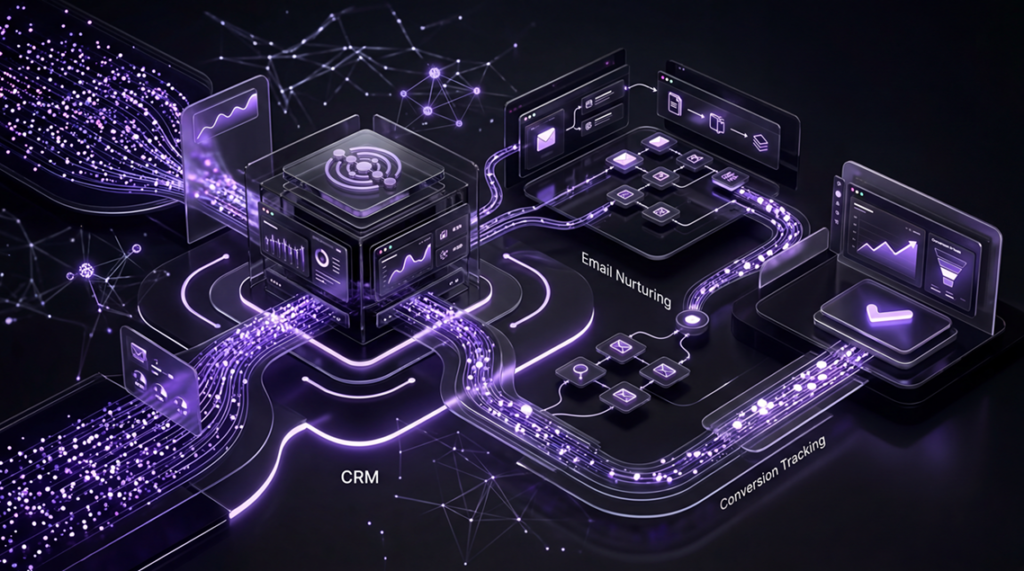
AI lead nurturing helps businesses replace slow, manual follow-up with a more intelligent system for scoring, segmenting, and moving leads toward conversion. When it is connected to your CRM, email workflows, and content system, AI can improve timing, relevance, and handoff quality across the funnel. For a broader foundation, see our guides on How to Implement Marketing Automation and What Is Artificial Intelligence in Content Marketing.
What Is AI Lead Nurturing?
AI lead nurturing is the use of artificial intelligence to guide prospects through the sales funnel with personalized, timely, and relevant interactions. Instead of relying on static rules or guesswork, AI analyzes behavior, engagement patterns, firmographic data, and intent signals to help deliver the right message at the right time.
Example: Think of AI lead nurturing as a digital sales assistant that continuously watches for intent, updates priorities, and recommends the next best action. McKinsey’s 2025 State of AI report found that 78% of organizations use AI in at least one business function, with marketing and sales among the most common areas of adoption. |
|---|
How Does AI Improve Lead Scoring?
Compared with manual lead scoring, AI makes prioritization more dynamic, data-driven, and easier to scale. Instead of relying on a fixed spreadsheet or a few assumptions about fit, AI continuously reevaluates lead quality as new data comes in. That helps sales teams spend less time on low-intent contacts and more time on opportunities that are actually moving.
Step 1. Dynamic and Predictive Scoring
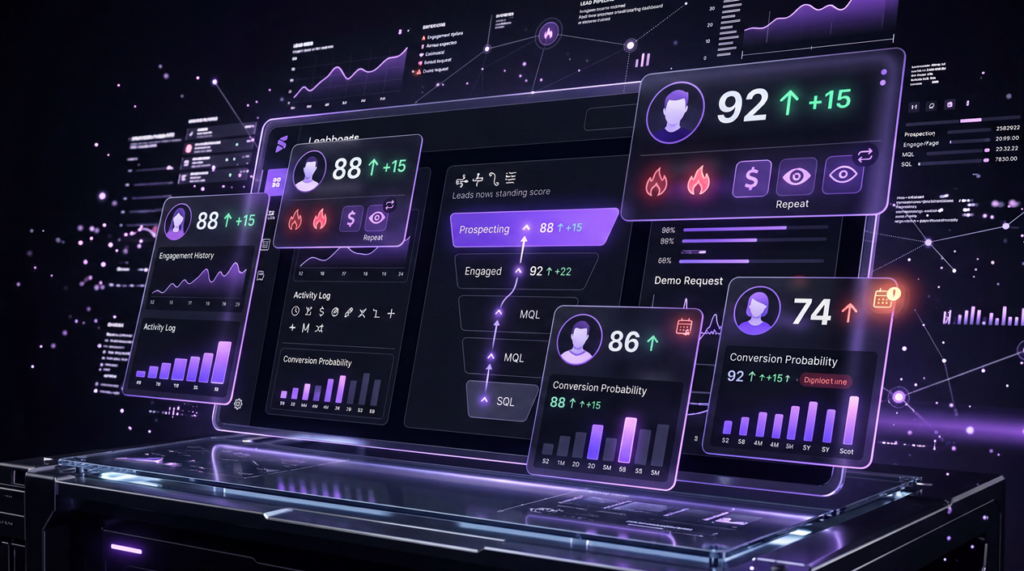
Traditional lead scoring is often based on static criteria such as job title, company size, or a few page visits. Predictive scoring improves that model by identifying patterns that historically correlate with conversion.
Because AI updates scores in real time, a lead’s priority can rise the moment they revisit your pricing page, request a demo, or engage with a campaign. Platforms such as HubSpot lead scoring and Salesforce Einstein are built around this kind of continuously updated scoring logic.
Step 2. Deep Behavioral Analysis
AI does not stop at simple clicks. It can analyze browsing depth, repeat visits, email engagement, form activity, and content consumption patterns to uncover intent signals that a manual review might miss.
Step 3. Elimination of Human Bias
Manual scoring is rarely as objective as teams assume. People tend to favor leads that look familiar or seem promising on instinct. AI reduces that bias by evaluating every lead against the same data model and weighting signals more consistently.
Step 4. Improved Sales and Marketing Alignment
AI also improves alignment between sales and marketing because both teams can work from the same lead data, scoring rules, and activity history.
When the CRM, automation platform, and reporting layer are connected, teams see the same qualification signals instead of debating handoff quality after the fact. If you want the operational side explained in more detail, read our guide on How to Implement Marketing Automation.
Step 5. Real-time Prioritization
AI-based prioritization shortens the gap between intent and response. Instead of waiting for a weekly report or a manual review, the system can flag hot leads immediately, trigger outreach, or route the opportunity to the right rep while interest is still high.
What Are the Best Ways AI Improves Conversions?
Most funnels lose more leads than they convert because timing, relevance, and follow-up quality break down before a prospect is ready to buy. AI improves conversions by making those systems more responsive, more personalized, and less dependent on manual execution.
1. Personalization at Scale
Personalization at scale is one of AI’s strongest advantages. Instead of sending the same generic sequence to everyone, AI can tailor emails, recommendations, and follow-up paths based on behavior, segment, lifecycle stage, and past engagement. That matters because customer expectations for relevance are now significantly higher, as McKinsey’s research on personalized marketing has shown.
2. Predictive Lead Scoring
Predictive lead scoring improves conversion efficiency because it helps teams focus on the leads most likely to move. Rather than spreading attention evenly across the pipeline, sales can prioritize prospects with the strongest combination of fit, behavior, and momentum.
3. Instant “Speed to Lead”
Speed to lead is another major conversion lever. AI-powered chat, instant routing, and triggered follow-up emails reduce the delay between interest and response, which is often where momentum is lost.
4. Automated, Triggered Workflows
AI also makes automated workflows more useful because triggers can be based on real behavior instead of rigid schedules. If a lead downloads a guide, watches a webinar, or revisits a solution page, the next step can change automatically. Our article on How to Implement Marketing Automation explains how to build these systems more strategically.
5. Enhanced Content and Recommendations
Finally, AI improves content and offer recommendations by matching each lead with the next asset most likely to help them move forward. That could mean surfacing a case study after a pricing-page visit, a comparison guide after a product-view sequence, or a tailored nurture email after repeated blog engagement. For a wider look at this layer, see What Is Artificial Intelligence in Content Marketing.
Lead Personalization with AI in Email Marketing
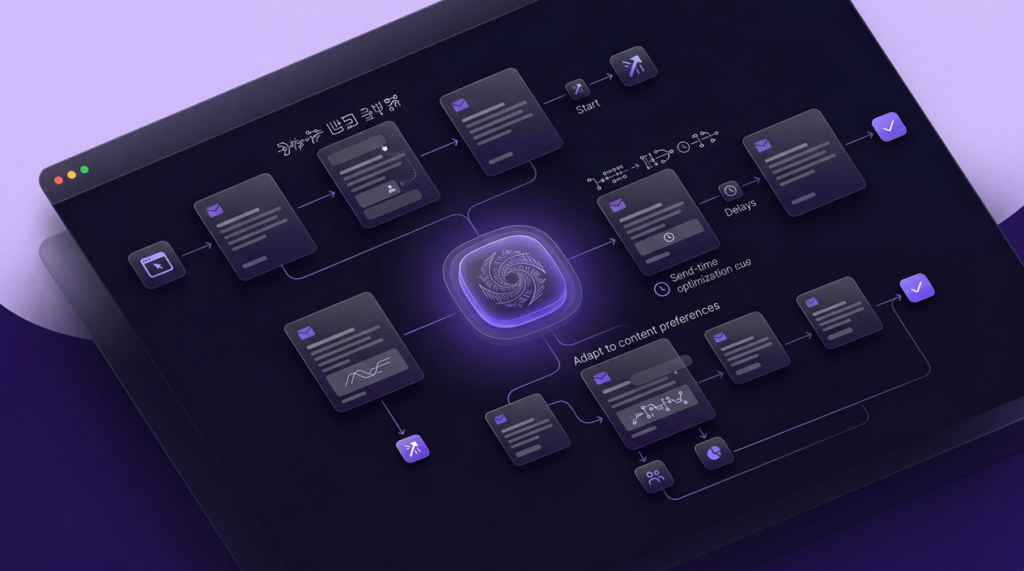
Email is still one of the most effective channels for lead nurturing, but generic batch sends do not carry the same weight they once did. AI email personalization makes the channel more precise by adapting content, timing, and offers around each contact’s behavior. We go deeper on this in Generative AI for Email Marketing.
- Subject lines
- Product, service, or content recommendations
- Send time optimization
- Message blocks, offers, and calls to action
All of these elements can be optimized at the contact level rather than at the list level.
The result is usually better open rates, stronger engagement, and more efficient conversion paths, especially when personalization is tied to behavior instead of just basic segmentation. Platforms such as ActiveCampaign Predictive Sending show how timing alone can be optimized with AI.
AI Chatbots for Lead Nurturing: Efficiency and Benefits
Modern chatbot platforms are no longer limited to rigid scripts and canned replies. The strongest options use conversational AI to answer questions, qualify leads, route conversations, and book meetings in real time.
- Tools such as Drift and Intercom are designed to qualify leads, keep conversations moving, and reduce the lag between visitor intent and sales follow-up.
- That makes AI chatbots especially valuable for top-of-funnel and mid-funnel lead capture, where fast answers and clean handoffs can materially improve conversion rates.
Predictive Analytics in Sales Funnels
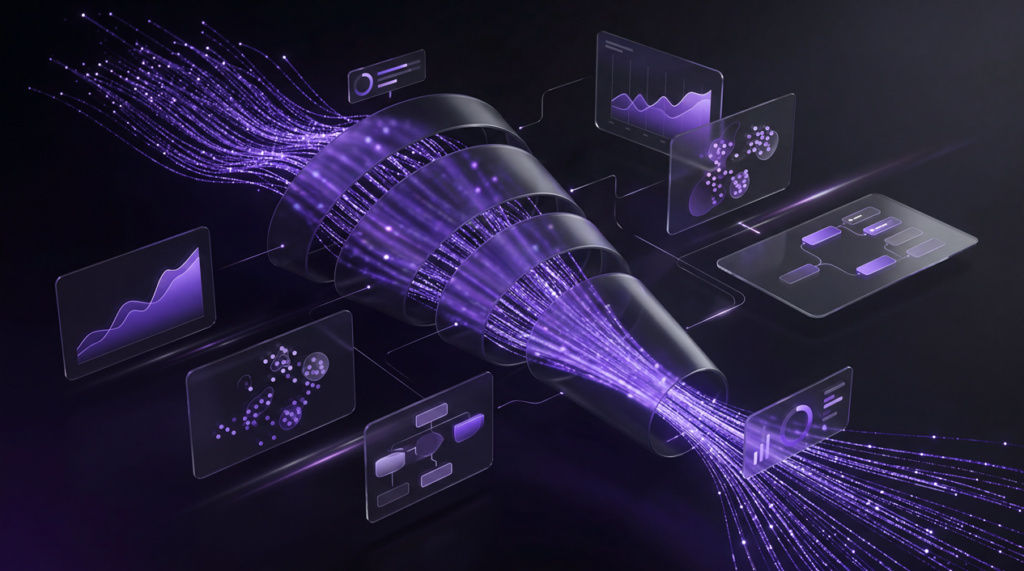
Predictive analytics is where AI becomes especially valuable for sales funnels. By analyzing historical performance and current behavior, AI can estimate which leads are most likely to convert, what content tends to move them, and when intervention is most useful. That helps businesses allocate attention more strategically instead of reacting after the opportunity has gone cold.
What Are Some of the Best AI Lead Nurturing Tools?
There is no single best platform for every business. The right choice depends on your sales cycle, data maturity, team size, and whether you need stronger CRM depth, better email automation, or faster conversational engagement. The tools below are among the strongest options for AI-assisted lead nurturing.
Tool | Overview | Key Features |
|---|---|---|
A strong all-in-one option for businesses that want CRM, marketing automation, and lead scoring in one system. | Lead scoring, workflows, segmentation, CRM visibility, and email personalization. | |
Best for teams already using Salesforce and needing advanced, continuously updated lead intelligence. | AI lead scoring, pattern analysis, activity-based insights, and sales prioritization. | |
A conversational platform built for real-time engagement, qualification, and routing on the website. | AI chat, lead qualification, conversation routing, and meeting scheduling. | |
A practical choice for businesses that need email automation, behavioral triggers, and send-time optimization. | Automations, predictive sending, dynamic content, and segmentation. |
If you are comparing platforms more broadly, our roundup of the best marketing automation software for startups can help you evaluate fit more strategically. The point is not to buy the most complex tool. It is to choose the system that fits your team, data, and sales process.
Final Words
AI lead nurturing improves conversions when it is used to strengthen timing, relevance, prioritization, and handoff quality across the funnel. Predictive scoring, personalized email, conversational AI, and CRM automation all become more effective when they work as one connected system.
For businesses that want to move beyond disconnected tactics, that is the real opportunity: not just using AI to automate follow-up, but using it to build a smarter conversion infrastructure. If you want a broader view of how that model works, read What Is an AI Marketing Agency?.