Skip to content
Lead Generation vs Lead Nurturing: Key Differences Explained
| TL;DR: Lead generation attracts attention and captures interest. Lead nurturing builds trust until that interest becomes buying readiness. Treating them as the same process usually leads to weak handoffs, wasted budget, and lower conversion rates. In this guide, you’ll see where each fits in the funnel, how they work together, and which one to prioritize based on your current bottleneck. |
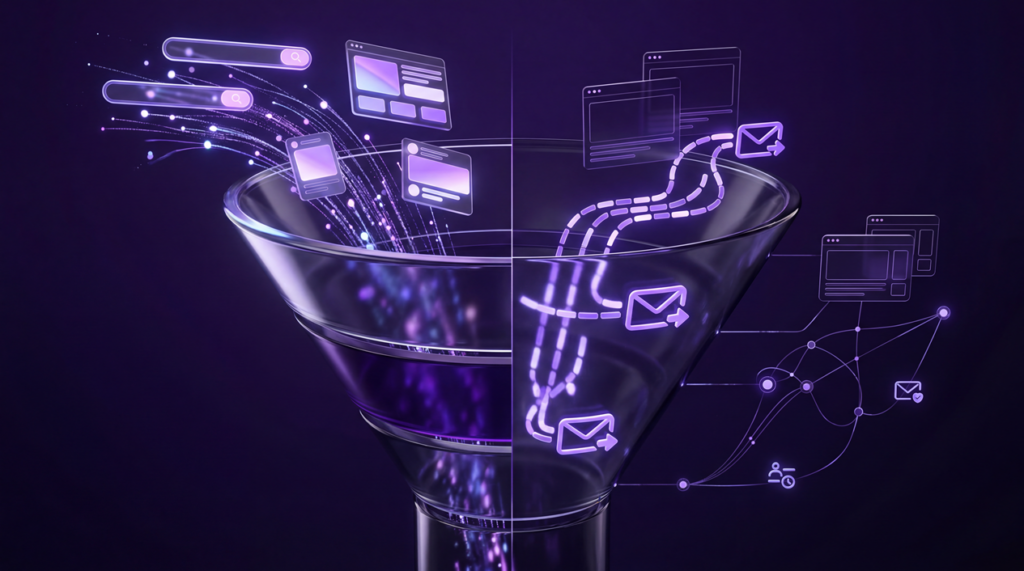
What’s the difference between lead generation and lead nurturing? One creates the first signal of demand. The other develops that demand into trust, intent, and readiness to buy.
A simple way to think about it is this: lead generation gets people in the room. Lead nurturing gives them a reason to stay, engage, and eventually choose your brand.
Both are essential, but they solve different problems. When businesses treat them as interchangeable, they often chase more leads when the real issue is weak follow-up, poor timing, or unclear messaging. That is where performance starts to break down.
What is Lead Generation?
Lead generation is the process of attracting potential buyers and getting them to raise their hands. That usually happens through search-optimized content, landing pages, webinars, downloadable resources, paid campaigns, and social posts that turn anonymous attention into identifiable interest.
At this stage, the goal is straightforward: create interest and capture enough information to continue the conversation. It sits at the top of the funnel, where visibility, relevance, and offer strength matter most. For a broader definition, Salesforce’s lead generation guide describes lead generation as building interest in a product or service and moving that interest toward a sale.
| Note: Demand generation often overlaps with lead generation. Demand generation builds awareness and interest at scale, while lead generation converts that interest into identifiable prospects. In practice, a brand might run awareness content to earn attention first, then use a webinar, checklist, demo, or gated resource to capture lead information. |
What is Lead Nurturing?
Lead nurturing is the process of building trust with prospects who are not ready to buy yet. Instead of pushing for an immediate sale, nurturing moves people forward with relevant content, thoughtful timing, and personalized follow-up.
In practical terms, that usually means three things:
• Targeted content that matches the prospect’s stage, problem, and level of awareness.
• Timing that reflects behavior and intent instead of random follow-up.
• Personalization that makes the message feel relevant rather than generic.
Salesforce defines lead nurturing as providing valuable offers and resources that help prospects move through the funnel. In other words, the objective is not to force a sale. It is to reduce uncertainty, answer objections, and keep your brand relevant until the buyer is ready.
Typical tactics include email sequences, retargeting campaigns, case studies, product education, demos, and stage-specific follow-up. When paired with the right marketing automation process, nurturing can scale across channels without losing relevance. If you want to build that system properly, start with our guide on how to implement marketing automation.
Lead Generation vs Lead Nurturing: Key Differences
The cleanest distinction is this: lead generation creates opportunity; lead nurturing increases the value of that opportunity. One fills the pipeline. The other determines how much of that pipeline actually turns into revenue.
Here is a simple comparison:
| Aspect | Lead Generation | Lead Nurturing |
| Primary goal | Capture attention and convert traffic into leads. | Build trust and move qualified prospects toward a decision. |
| Funnel position | Top of funnel; awareness and initial interest. | Mid-to-bottom funnel; education, evaluation, and readiness. |
| Core metrics | Traffic, cost per lead, conversion rate, and source quality. | Engagement, marketing-qualified leads, reply rate, pipeline velocity, and conversion rate. |
| Common tactics | SEO, paid ads, webinars, landing pages, content offers, and social campaigns. | Email sequences, retargeting, case studies, demos, lead scoring, and personalized follow-up. |
| Mindset | Reach and acquisition. | Relevance, trust, and timing. |
In short: lead generation starts the relationship. Lead nurturing builds the conditions that make conversion more likely.
Lead Generation vs Lead Nurturing: Working Together in the Sales Funnel
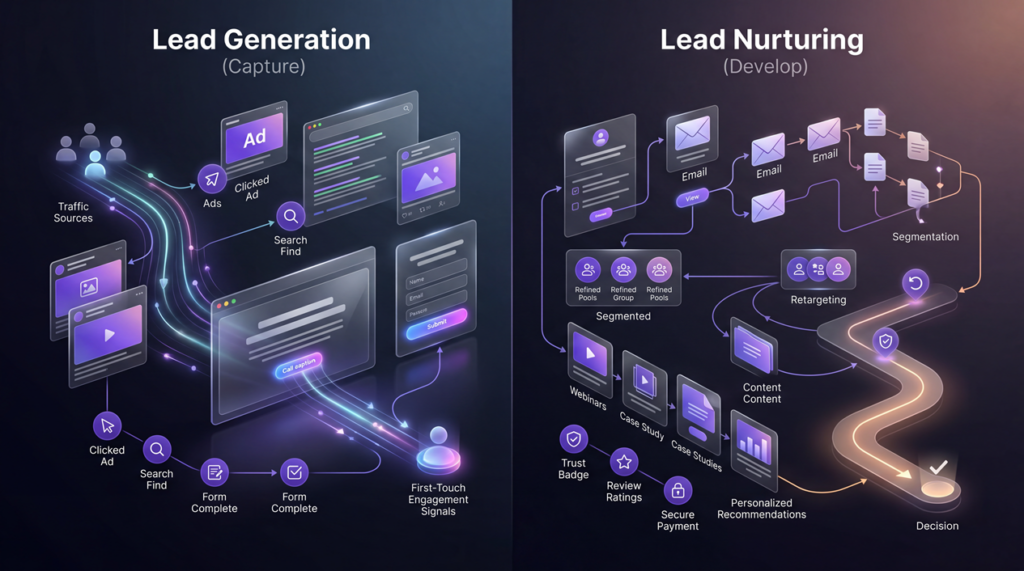
The strongest systems do not separate lead generation and lead nurturing into different silos. They connect them. Lead generation creates the first signal of intent. Lead nurturing develops that signal until sales has enough context to step in at the right moment.
A simple way to picture the flow is a coordinated relay:
• Lead generation creates awareness and captures the first expression of interest.
• Lead nurturing builds trust through education, timing, and personalized follow-up.
• Sales steps in when the lead is better informed, better qualified, and closer to a decision.
Here is a practical four-step workflow:

Step 1 — Awareness (Lead Generation)
Use a blog post, social campaign, video, or webinar to attract the right audience and create initial curiosity. At this stage, the message should focus on relevance, clarity, and a strong value proposition.
Outcome: More qualified attention and a larger pool of prospects entering your funnel.
Step 2 — Interest (Lead Capture)
Turn that attention into identifiable demand with a strong offer: a checklist, guide, webinar registration, free consultation, or demo. Reduce friction with short forms, clear CTAs, and a visible reason to opt in.
Outcome: Captured leads with enough data to personalize the next step.
Step 3 — Consideration (Lead Nurturing)
Use email nurturing, retargeting, product education, and proof-based content to answer questions and reduce doubt. This is where segmentation and automation start to matter. If you are selecting tools for that stage, our breakdown of the best marketing automation software for startups can help you evaluate practical options.
Outcome: Warmer leads, stronger engagement, and a clearer signal of buying readiness.
Step 4 — Decision (Sales Handoff)
Once the lead shows meaningful intent, pass the conversation to sales with context: engagement history, key objections, relevant pages viewed, and the content they responded to. Clean handoffs reduce friction and improve close rates.
Outcome: Shorter sales cycles and a better chance of converting qualified demand into revenue.
| Note: When acquisition and nurturing are aligned, the funnel becomes more efficient. Better messaging at the top improves lead quality, and better follow-up in the middle improves conversion quality. |
Lead Generation vs Lead Nurturing: Common Misconceptions
Myth 1 — “More leads always equals more revenue.” Not necessarily. More unqualified leads can waste sales time, inflate cost, and hide the real issue, which is often poor qualification or weak follow-up.
Myth 2 — “Lead nurturing is just automated email.” Automation helps, but nurturing is broader than email. It includes segmentation, behavior-based timing, retargeting, education, and message sequencing across channels.
Myth 3 — “Lead generation and lead nurturing are interchangeable.” They are connected, but they are not the same discipline. Confusing them usually leads to weak funnel design, wasted ad spend, and inconsistent customer acquisition.
Myth 4 — “Lead nurturing is only for B2B.” That is also wrong. B2C brands nurture leads too, especially when the purchase involves comparison, consideration, or repeat buying behavior.
Which One Should You Focus On between Lead Generation and Lead Nurturing?
The honest answer is both, but not always in equal proportion. Your priority should depend on the bottleneck inside your funnel.

• Low traffic and weak lead volume → prioritize lead generation so you have enough qualified attention entering the funnel.
• Healthy traffic but low conversions → prioritize lead nurturing so existing demand has a better chance of becoming revenue.
• An active pipeline with slow sales cycles → improve segmentation, lead scoring, and mid-funnel content so sales receives better-prepared prospects.
Track acquisition metrics for lead generation and engagement-to-opportunity metrics for lead nurturing. Looking at only one side of the system usually creates distorted decisions.
Pro tip: Pair your lead-nurturing strategy with cleaner automation, better segmentation, and a tool stack that matches your growth stage—not just the biggest platform in the category |
Closing Thoughts
Lead generation fills the pipeline. Lead nurturing determines how much of that pipeline becomes revenue. One without the other creates waste.
The strongest systems connect both: strong acquisition at the top, relevant follow-up in the middle, and a clean sales handoff near the bottom.
That is the difference between isolated tactics and real marketing infrastructure. If you want to build a stronger system around your content and customer acquisition, Marketing Media AI focuses on the structure behind performance—not just the output itself.