

Did you know the nonprofit sector is constantly evolving with technology? Technology plays a crucial role in helping organizations achieve their missions more effectively. One of the most transformative innovations of today is AI for nonprofits. As a result, 70% to 82% of non-profit organizations report using AI in some capacity!
Moreover, they use AI often through free or existing generative AI tools. AI technology for charities is reshaping how organizations operate, communicate, and deliver impact. In case you want to know how, we will discuss what the phrase ‘AI for nonprofits’ really means to companies, and how it’s starting to, and has already been benefiting them. We will also discuss practical applications and some real-world examples.
✨ Key Points in the Blog:
- What is AI for nonprofits, their purpose, and how NLP, generative AI, and predictive AI work together for the best results?
- List of the best AI tools available for nonprofits, alongside their challenges, and the future of machine learning for nonprofits.
- Total benefits of AI for non-profit organizations, and how organizations like the American Cancer Society benefited from it
What is AI for Non-Profits?
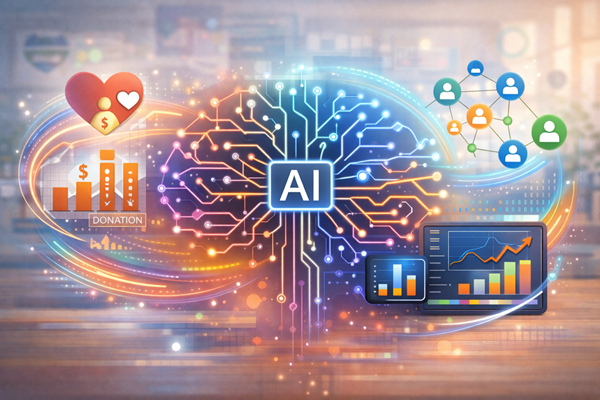
AI for nonprofits is the opposite of traditional software. In fact, AI systems learn from data and adapt over time. For nonprofits, this means more brilliant donor insights, automated reporting, and even artificial intelligence content marketing campaigns that resonate with supporters.
So, in plain language, AI for nonprofits is the use of artificial intelligence technologies, such as machine learning for nonprofits, natural language processing, generative AI analytics, and predictive analytics, and all of these are used for bigger purposes:
- To streamline operations
- To enhance fundraising
- To improve program delivery
# Predictive AI for nonprofits
Predictive AI helps nonprofits analyze donor data, forecast fundraising outcomes, and identify patterns to guide strategic decisions. A nonprofit might use predictive analytics to determine that donors who attended events twice in a year are 70% more likely to give again.
# Generative AI for Non-profits
Generative AI creates personalized content—like emails, social posts, and donor communications automatically. You can save time and boost engagement in this process. A nonprofit can use the best LLM AI for business, including marketing, to draft multiple versions of a fundraising appeal, then test which resonates most with donors. So, for nonprofits (and just like everyone else in the world who has been dabbling with the generative AI experience), this can save a lot of time, and they can get a lot more done.
# NLP AI for Nonprofits
Natural Language Processing (NLP) helps nonprofits analyze text data, automate communications, and better understand donor and beneficiary needs. It powers chatbots, sentiment analysis, and content creation, making nonprofit operations more efficient and impactful.
Key Benefits of AI for Nonprofit Organizations

Do you know that 60% of non-profits are interested in using AI for grant writing and fundraising optimization? It outlined the benefits they get from using AI for nonprofits. After all, the adoption of AI technology for charities offers several advantages. We have listed the most common benefits you will surely get:
#1. Efficiency through Nonprofit Automation Tools
One of the most immediate benefits of AI for nonprofits is the efficiency gained through nonprofit automation tools. These tools take over repetitive administrative tasks such as donor data entry, volunteer scheduling, and grant application tracking. If the non-profit organizations automate these processes, they can reduce human error and free up valuable staff time.
#2. Enhanced Fundraising with Machine Learning
Fundraising is the backbone of most nonprofit organizations, and machine learning for nonprofits is revolutionizing this area. Predictive analytics can analyze donor behavior to identify high-value supporters. They also forecast donation trends and segment donors into meaningful groups.
#3. Personalized Communication with Generative AI
Generative AI for email marketing makes personalization effortless. Rather than sending generic appeals, nonprofits can craft tailored messages, automated thank-you notes, and campaign updates that resonate with individual supporters. So, nonprofits can maintain consistent, compelling communication across multiple channels without overwhelming their staff.
#4 Better Decision-Making with AI Dashboards
Nonprofits often face challenges in making sense of large amounts of data, but AI-driven dashboards simplify this process. These dashboards provide real-time insights into program performance. Hence, nonprofits can identify what’s working, address gaps quickly, and allocate resources where they will have the most significant impact.
Practical AI Use Cases for Nonprofits
-
Case Study: American Cancer Society
The American Cancer Society utilized machine learning to identify the most effective communication channels and messages for donors, leading to a 400% increase in donation conversion rates.
-
Case Study: Parkinson’s UK
Parkinson’s UK used AI to identify high-likelihood donors, reduce its mailing list, and increase revenue by 23%. The impact is huge! They have completed smarter targeting, increased revenue, and deeper relationships.
-
Case Study: TalkingPoints
Analyzing data from surveys and case management systems to measure outcomes and identify trends. Applying this theory, TalkingPoints analyzed 40 million text messages and found that 78% of support time was spent on questions that could be answered by an FAQ, leading to improved resource allocation. So, they improved decision-making through faster learning cycles. It lessened their accountability to the stakeholders.
Best AI Tools for Nonprofits

The top AI Tools for nonprofits include ChatGPT/Gemini/Claude for writing, Canva Magic Studio for design, Otter.ai for transcription, HubSpot/DonorSearch AI for donor management, and tools such as Grantable for grant writing. It is clear that several nonprofit automation tools and platforms stand out. Apart from every aspect, we have listed some tools that are highly effective in strategy building and deployment.
- Salesforce Nonprofit Cloud with AI add-ons: Integrates donor management with predictive analytics.
- HubSpot with AI-driven marketing automation: Ideal for artificial-intelligence-content-marketing.
- Grammarly and Jasper AI: assist with content creation for blogs, newsletters, and donor communications.
- ChatGPT and Other: Best LLM AI for business, including marketing, and it generates donor insights, fundraising scripts, and campaign strategies.
- Mailchimp with generative AI for Email marketing: Automates personalized donor outreach.
- Google AI for nonprofits: offers free or discounted AI-powered tools like analytics and cloud services.
✨ Note: Are you interested in using those tools? You can explore them with or without premium plans. An estimated 900 million people worldwide actively use AI tools as of 2025. More importantly, 40% of them are marketers! They can leverage their existing knowledge and further optimize outcomes with AI tools.
How to Implement AI in a Nonprofit (Step-by-Step)
Implementing AI for nonprofits requires a structured approach:
- Step 1: Determine where nonprofit automation tools can save time or improve outcomes.
- Step 2: Choose platforms that align with your mission, such as AI technology for charities focused on fundraising or program evaluation.
- Step 3: Train staff and ensure employees understand how to use machine learning for nonprofits effectively.
- Step 4: Connect AI tools with donor databases, CRM platforms, and communication channels.
- Step 5: Start small, such as using generative AI for email marketing for one campaign.
- Step 6: Now, measure impact! Track KPIs like donor retention, fundraising growth, and volunteer engagement.
- Step 7: Finally, expand AI use across departments once proven successful.
Challenges Nonprofits Face with AI

AI for nonprofits offers immense potential, but there are challenges that remain at the same time! Despite its promise, organizations often encounter significant challenges when adopting AI technology for charities. The top challenges are: cost barriers, privacy concerns, skill gaps, and integration issues.
# Challenge 1: Cost Barriers
Even with discounted access, AI technology for charities can be expensive, particularly for small organizations with limited budgets. Implementing nonprofit automation tools or advanced machine learning for nonprofits requires investment in software, training, and ongoing maintenance. So, affordability is one of the most pressing challenges in adopting AI for nonprofits.
#Challenge 2: Data Privacy Concerns
Protecting donor and beneficiary information is critical when using machine learning for nonprofits. AI systems often rely on large datasets to generate insights, raising concerns about how sensitive data is stored, shared, and secured. Also, nonprofits must comply with strict data protection regulations while maintaining trust with supporters. The risk is: any breach could undermine fundraising efforts and damage the credibility of AI technology for charities.
#Challenge 3: Skill Gaps
Although nonprofit automation tools and best LLM AI for business, including marketing, are becoming more accessible, many nonprofit staff lack the technical expertise to manage them effectively. Bridging this skill gap requires investment in education or partnerships with AI marketing agencies, which can be difficult for resource-constrained nonprofits.
#Challenge 4: Integration Issues
Finally, many nonprofits rely on legacy systems that do not easily connect with modern AI platforms or AI marketing agencies. Integrating new tools with existing donor databases, CRM systems, or program management software can be technically complex. It can undermine the efficiency promised by nonprofit automation tools and AI technology for charities.
Future of AI in the Nonprofit Sector
The future of AI for nonprofits is promising. You already know the best LLM AI for business including marketing becomes more accessible. Nonprofits will harness predictive analytics, automated storytelling, and advanced donor segmentation to solve their problems at lower costs.
Summary of the Emerging Trends:
- Generative AI for email marketing is evolving into full campaign automation.
- AI-powered storytelling tools that create immersive donor experiences.
- Partnerships with AI marketing agencies to run sophisticated campaigns.
- Greater adoption of machine learning for nonprofits to evaluate social impact at scale.
Ultimately, AI technology for charities will empower organizations to achieve more with fewer resources, ensuring that missions are fulfilled more effectively.
Conclusion
AI for nonprofits is a practical solution that is transforming the way charities operate. The journey may involve challenges, but the benefits far outweigh the risks. As the nonprofit sector continues to evolve, those who adopt AI technology for charities will be better positioned to thrive in a data-driven world.
FAQs on AI for Nonprofits
Do users have to be tech-savvy to use AI for nonprofits?
Not necessarily. Modern no-code platforms and user-friendly AI technology for charities have minimized the need for specialized technical expertise. Nonprofit staff can set up and manage nonprofit automation tools with slight training.
Is there any risks to consider with AI for nonprofits?
Machine learning for nonprofits also comes with risks. During the training session, privacy concerns, potential algorithmic bias, and the need for human oversight are critical issues to address. To avoid the risks, companies should use proven AI tools and platforms.
What percent of nonprofits use AI?
According to Twillo’s research, approximately 90% of nonprofits already use AI tools in some capacity, particularly for donor engagement, marketing, and communication workflows. There’s a rapid increase in charities developing AI policies, with one report showing a year-over-year jump from 16% to 48%.